

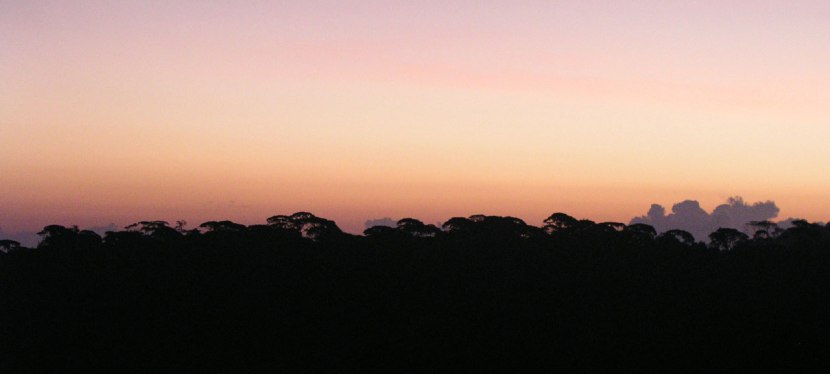
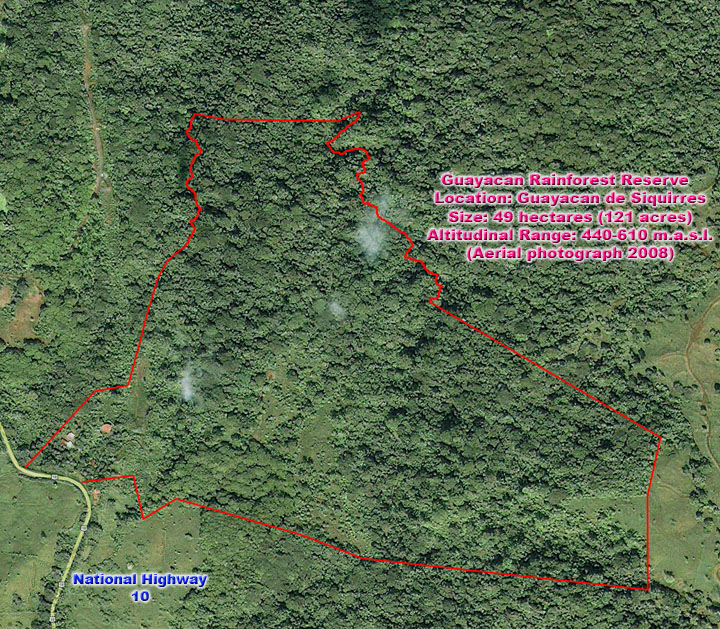
The Guayacán Rainforest Reserve, is nestled in the central Caribbean slopes in the foothills of northern Talamanca, near the small village of Guayacán de Siquirres. This private reserve has a total area of 49 hectares (121 acres) and is located in the upper catchment basin of the Siquirres River, in a government protected watershed area known as the “Zona Protectora Cuenca Río Siquirres”. To date 57 species of amphibians have been documented within the Guayacán Rainforest Reserve, including several very rare species. The Guayacán Rainforest Reserve is located on National Highway 10, nine highway kilometers south of the city of Siquirres. The reserve is very easy to get to, being only two hours from the Costa Rican capital of San José, ten minutes from Siquirres, 45 minutes from Turrialba, and less than an hour from Puerto Limón. Access from these towns is along blacktopped highways. Sorry, there are no dusty pothole-filled dirt roads, and a 4×4 vehicle is NOT required to arrive at the Guayacán Rainforest Reserve.
Flora and Fauna of the of the Guayacán Rainforest Reserve
In the Guayacán Rainforest Reserve two life zones are represented, that of Tropical Wet Forest, and Tropical Premontane Rain Forest (Holdridge 1967). The areas within the reserve recognized as Tropical Wet Forest are those with an altitude less than 500 m.a.s.l., whereas the areas with an altitude greater than 500 m.a.s.l. are classified as Tropical Premontane Rain Forest.
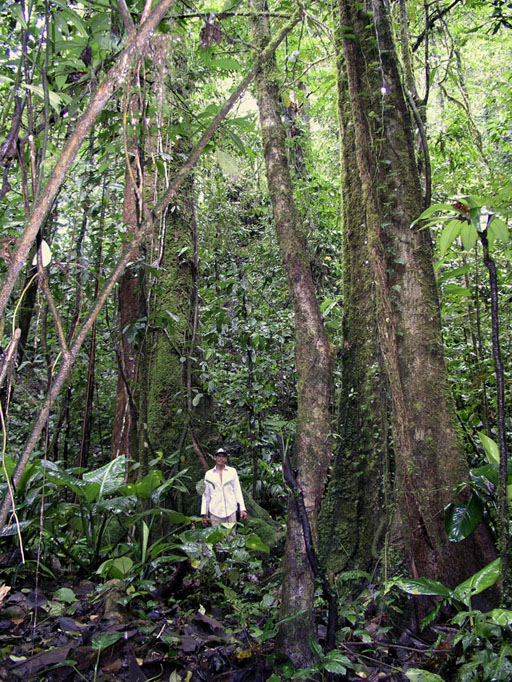
The abundant rainfall, stable intermediate temperatures, high relative humidity, and varied topography at the Guayacán Rainforest Reserve create conditions that are favorable for an astonishing diversity of flora and fauna. Having a low to intermediate altitude (average from 400–650 m.a.s.l.) general area of Guayacán presents an interesting assemblage of biological diversity. At these altitudes many plant and animal assemblages of lowland and mid-elevation species overlap, and this plays a key role in the rich biological diversity of the region.

Some Examples of Additional Fauna Found on the Guayacán Rainforest Reserve.


Several species of scorpions are known to exist within the Guayacán Rainforest Reserve, including two very rare and poorly known taxa, Chactas exsul (left and upper right) and Tityus cerroazul (lower right). The species C. exsul was rediscovered by Brian Kubicki after nearly 50 years since its last known collection. Tityus cerroazul was documented for the first time in Costa Rica in 2005.


These interesting creatures (above), known as velvet worms, have their own unique phylum (Onychophora). These prehistoric animals are believed to have remained relatively unchanged for millions of years. The velvet worms are restricted to scattered regions throughout the tropical latitudes of the world. Three phenotypically distinct forms have been found in the Guayacán Rainforest Reserve, and it is assumed that all three represent separate species, but unfortunately there exists very little literature regarding the identification of Costa Rican velvet worms. The above images show two of the three that have been found within the reserve. The red velvet worm (upper left), Peripatus solorzanoi, measuring up to 20 cm in length, is occasionally seen foraging among the mossy rocks on the edges of streams, or on the forest floor at night. Peripatus solorzanoi was just recently described as a new species in 2010. The velvet worm to the upper right is less commonly observed, normally it is seen foraging on low-lying vegetation at night, and is believed to be an undescribed species. The third species(?) that has been found in the reserve is brown with fine darker markings; this third type of velvet worm is occasionally seen while looking through the leaf litter or searching through the organic remains of rotten logs.


The diversity of vertebrates is equally impressive. Guayacán is also well known for its diversity of reptiles, especially snakes, including many very rare species, one such example is the bushmaster (Lachesis stenophrys). Nearly 70 species of reptiles have been recorded within the Guayacán Rainforest Reserve. The reserve is also very rich in avian diversity, but thus far minimal efforts have been invested in creating a detailed bird list, nonetheless our minimal efforts have resulted in more than 200 species being documented within the reserve.


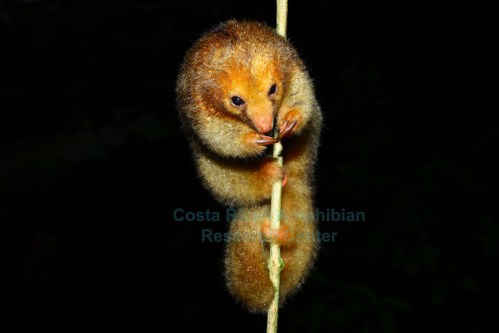
Numerous species of mammals also inhabit the reserve; among them are species such as ocelots, margays, white-faced and howler monkeys, collared peccary, sloths, tayras, olingos, and kinkajous.


Botanical diversity of the Guayacán Rainforest Reserve
For those who are into plants the Guayacán Rainforest Reserve is a must see location. With so much botanical diversity within the reserve it is hard to list them all, but some examples of are palms (more than 30 species), aroids (more than 30 species of just the genus Anthurium alone, likely more than 80 species of the aroid family Araceae), orchids, bromeliads, heliconias, and ferns. Within the Guayacán Rainforest Reserve it is possible to observe hundreds of amazing plant species while taking a casual walk along the different trails.


Above and below are some examples of the palm diversity in the Guayacán Rainforest Reserve, Reinhardtia gracilis (upper left) and Geonoma cuneata ssp. guanacaste (upper right), Geonoma ferruginea (below)


Below are some examples of the orchid diversity in the Guayacán Rainforest Reserve, Erycina (Psygmorchis) pusilla (upper left), Psychopsis krameriana (upper right), and Masdevallia tonduzii (below).


Below are two images of an extremely rare Heliconia species found within the Guayacán Rainforest Reserve, Heliconia calatheaophylla, which is a species not only endemic to Costa Rica, but known only to inhabit a small region in the vicinity of Siquirres.


Climate of the Guayacán Rainforest Reserve
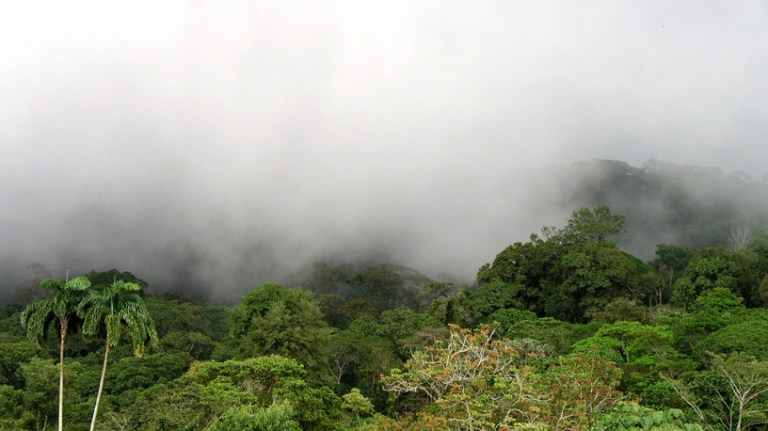
The region of Guayacán has a mild temperature range, with very little seasonal variation. The average temperatures range between a high of 26°–29°C, and a low of 18°–21°C. The diurnal temperatures can vary within the reserve depending on forest coverage. The highest temperatures are felt in the open areas on sunny days, where the increased solar energy causes higher terrestrial heat radiation. During the daylight hours there can be as much as a 5°C difference between the understory of dense forest and open areas.
The C.R.A.R.C. receives an abundant supply of rainfall due to orographic lifting conditions and convectional showers and storms. Guayacán gets an average annual rainfall of 5000–6000 mm, but as much as 7822 mm of precipitation has been recorded in a single year at the Guayacán Rainforest Reserve (data from a rain gauge). The area lacks a prolonged dry season. In the months of April through October strong convectional showers and thunderstorms occur with great frequency; storms producing lightning and thunder are for the most part uncommon during the rest of the year. During the months of November, December, January, and often lasting into February the rainfall can be much more continual during events that are known as “temporales”. Cold fronts coming in from the north and off the Caribbean Sea cause “temporales”, and their effect is directly linked to the Caribbean lowlands and slopes. The year of 2015 was unusually rainy on the Caribbean versant of Costa Rica due to the conditions caused by El Niño. During 2015 a total of 7822 mm (308 inches) of rainfall was recorded at the C.R.A.R.C. Guayacán Rainforest Reserve.
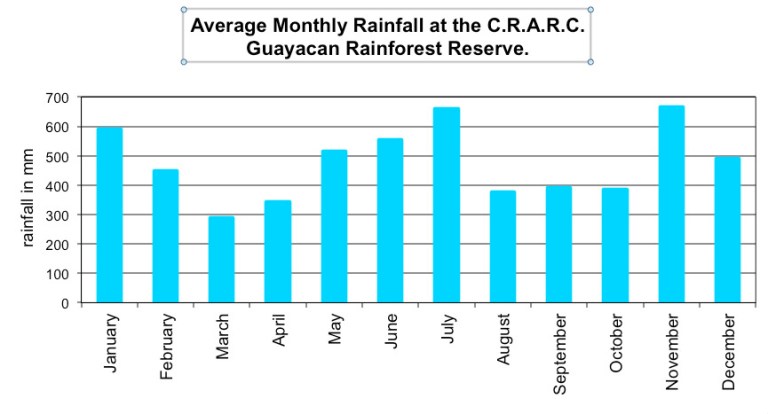
The relative humidity in the Guayacán Rainforest Reserve is high, with an average range from 75–100% throughout the day and evening.
Strong Wind conditions are unusual to rare in Guayacán, but light breezes between 1–10 km/hour often occur, especially in the afternoons or during changing weather fronts. The sections of Guayacán that receive the highest air movement are the upper ridges, where light breezes are commonly present.
Aquatic Resources of the Guayacán Rainforest Reserve
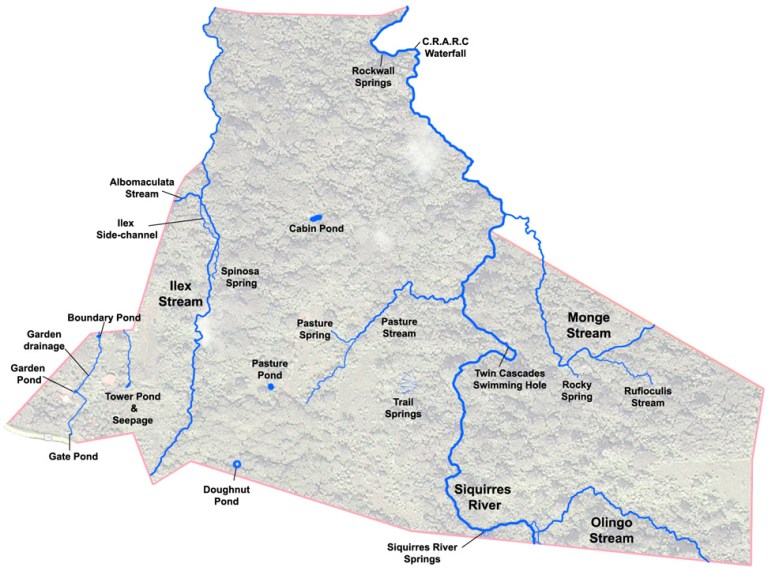
Due to the heavy annual rainfall in the region of Guayacán the C.R.A.R.C. Guayacán Rainforest Reserve is very rich in aquatic resources. Such aquatic resources include swampy areas, ponds, seepages, springs, streams, and the Siquirres River. Within the reserve there are 7 ponds, 16 (rivers, streams, seepages, and springs), and several swampy areas. There are more than 3900 meters of riparian habitat found within the Guayacán Rainforest Reserve. Several of the smaller streams actually originate within the reserve’s boundaries.


 Costa Rican Amphibian Research Center